Sunday, 25 May 2014

The first bioblitz of the year!

Last weekend was a busy one.  Saturday was the first ever Shotover Conference, celebrating almost 200 years of biological recording at Shotover Country Park, a fantastic SSSI to the northeast of Oxford (and the setting for a previous blog post!).  Then it was over to south Northamptonshire for my first BioBlitz of the year, an invitation-only event at Halse Copse, run by the Northamptonshire Biological Records Centre.  For those who haven't yet encountered a BioBlitz, the best way to think of it is like Time Team for wildlife - the aim is to find as many species as possible in (roughly) 24 hours, and generally showing the general public just what natural riches can be found on their doorstep.

There was a reason we were at Halse Copse in particular: the two patches of ancient woodland and associated meadows are right in the path of the projected route of HS2.  Historically under-studied, the record centre held records for just 171 species in the Local Wildlife Sites, making them (apparently) much less biodiverse than my garden - which just goes to show the value of surveying thoroughly!  The BioBlitz was an attempt to get a better picture of the diversity in line to be destroyed.
Hard at work adding to the insect numbers...
Once we got to the site, it was immediately clear that the 171 species so far were a massive understatement.  A couple of hours (before lunch!) surveying the first meadow generated 105 species records in my notebook, plus a good number of beetles and bugs as yet unidentified.  Being slightly biased, my favourite was the inconspicuous ladybird Scymnus haemorhoidalis, swept from the grassland by my girlfriend Kate. We also found a rather pretty wood-boring beetle (Hedobia imperialis) in the woodworm family, and the first Small Copper butterfly (Lycaena phlaeas) ever recorded on site!
Scymnus haemorhoidalis, a 2mm hairy ladybird (pic Jo Bogaert)
The first Small Copper ever recorded at Halse Copse!
After a quick lunch consisting mainly of cake and tea (the essential food groups for any naturalist in the field!), we decided to try our luck in the more southerly of the two woodlands (which had contributed just 68 species to the grand total pre-BioBlitz, and just 3 insects).  The woodland was definitely less diverse (or at least the wildlife more elusive) than the meadow, but in a few hours surveying we had a list of 71 species identified there and then, with another series of beetles and bugs that needed checking under the microscope.  The afternoon highlights included several Brown Hares (Lepus europaeus) lounging around just outside the wood, and a beautiful orange-striped millipede, Ommatoiulus sabulosus, which were the first of their respective groups to be found at the site.  Also present in large numbers was another new species to me, the stripy brown click beetle Agriotes linearis, present in big numbers on hazel leaves.  This group of beetles has an impressive trick: when threatened, they first tuck in all their legs and appendages to look like a seed; then, if that doesn't work, they use a special joint between the thorax and abdomen to fire themselves skywards and out of reach.  The effect, particularly on a hard surface, can be quite impressive!
Ommatoiulus sabulosus, beaten from gorse
The click beetle Agriotes linearis, here in walking mode rather than catapulting itself through the air
 As we stopped off in the meadow for one last look, a rather special hoverfly presented itself.  Recognisable from the dark abdominal stripe and the huge snout, this was the hoverfly Rhingia campestris (also known as the Heineken fly, because it can reach the parts other flies can't reach (if you don't remember beer adverts from days gone by, that probably won't make any sense...)).  This species, by virtue of mounting its tongue on the end of a very elongated face, can reach deeper into flowers than most other fly species and consequently can feed on complex flowers that are otherwise mostly reliant on long-tongued bumblebee species for pollination,
The Heineken Fly, busy reaching further
 Waiting for me to finish poking around in the heap of dead wood, Kate had wandered off to photograph areas containing fewer spiders, when photography of a vetch flower was interrupted by the red ants (Myrmeca sp.) running up and down the stems. On closer inspection the ants were raiding the extra-floral nectaries (glands on non-flower bits of the plant which secrete nectar) and passing the nectar to each other.  Most plants produce nectar as a sweet treat to entice pollinating insects to visit their flowers: these extra-floral nectaries, by contrast, are nothing to do with pollination, but are instead a sneaky way for the plant to avoid being eaten - they ensure a good supply of ants across the plant, ready to evict or eat any small herbivores like caterpillars, while even big herbivores like rabbits aren't keen on a faceful of biting, stinging ants at every mouthful!
A red ant nose-deep in an extra-floral nectary
In a single afternoon, we at least doubled, if not trebled, the number of species known to occur in Halse Coppice: with a variety of other excellent naturalists also present, the site should be well on its way to 1000 species. Just goes to show the value of recording!

Wednesday, 30 April 2014

Minor taxonomical curiosities in the north

The weekend before Easter was a bit of a change - for once, the main targets for sightseeing weren't some of the UK's 40,000 invertebrates, but a few of those minor taxonomical curiosities, the vertebrates.

The back end of the week was the National Forum for Biological Recording's annual conference, held this year in Derby. These conferences always include a day in the field, as befits an organisation whose entire reason for existence is the promotion of biological recording. Seriously, recording your wildlife sightings somewhere like birdtrack or iRecord is one of the best (and easiest!) things you can do to help wildlife - the records are the only window in the world of wildlife for policymakers, planners, etc, and if you don't record your sightings no-one will ever know that species was there.

So on Saturday 5 of us headed northwards from Derby to the Derwent Valley for a day out with the Sorby Natural History Society, guided by local naturalist Derek Whitely. Scrambling up a precipitous hillside, we stumbled almost immediately across a pair of red grouse, then a couple of violet oil beetles, Meloe violaceus. Normally these are huge, with great big fat abdomens, but that's the result of a couple of week's solid eating - these were tiny, freshly emerged individuals with elytra longer than the small, pointed abdomen.
A freshly-emerged oil beetle, photographed by Paula Lightfoot
Continuing up the path, we were stopped in our tracks by a grey bird quartering low over the moor - a male hen harrier! These beautiful raptors are virtually extinct in England now, with continuing persecution of nesting pairs, so it was fantastic to get good views as it soared lazily by, less than twenty metres away.
 
Later in the day we began to see tufts of white fur caught up in the heather. In spring, in the Peak District, that can only mean one thing - moulting mountain hares! The theory was quickly proved correct - a strange pale lump moved, revealing itself to be a piebald hare, still mostly white on top, but with plenty of brown fur low down on the sides. These animals - Lepus timidus, the only native British member of the rabbit family - live up in the mountains in Scotland, the Peak District, and the Isle of Man, and they change colour seasonally, white in the winter to hide in the snow, and brown in the summer. One hare quickly became several - half a dozen in the end, all caught mid-change in their seasonal uncertainty.
Hard at work recording by Derwent Water: curlew above, oil beetles below. Photo: Paula Lightfoot
On the way back down I was distracted from whistling Golden Plovers and posing Wheatears by a couple of bumblebees - both stranded on the ground wondering what happened to the sun, both new to me - Bombus sylvestris and the beautiful Bombus monticola, my new favourite bee. Clearly I can't spend too long ignoring invertebrates!
The excellent Bombus monticola. Photo Paula Lightfoot, hand my own


Friday, 11 April 2014

Species galore!

I've had a productive couple of weeks for wildlife-spotting - spring is properly here and the insects in particular are responding to the change.

As the buds burst and flowers begin to appear, insects too are emerging from their winter dormancy. The new leaves are covered with leafhoppers and caterpillars, and the flowers with pollen beetles and bees.
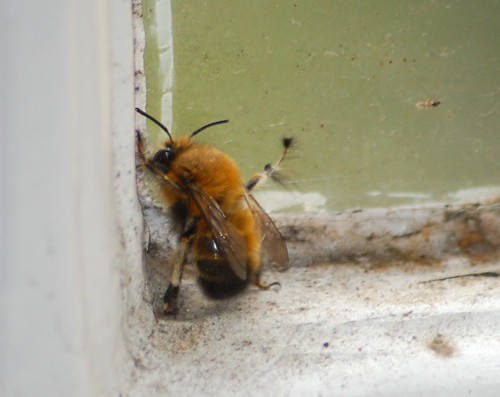
If you go by the media reports you might be forgiven for thinking there's just one British bee, the honeybee Apis mellifera. In fact, it's a bit more complicated than that - we have 1 honeybee, 25(ish) bumblebees and 230-250 species of solitary bees. Various bumbles and the honeybee visit my garden, but I'm lucky enough to have some of the solitaries call it home. In particular two species live in the back wall of my house. One of the signs of early spring is the colony of Hairy-footed flower bees (Anthophora plumipes) waking up, darting at high speed between flowers and zipping in and out of the holes in the wall. Zipping is really the word too - electrifyingly fast, the males in particular seem to move flower to flower without occupying the intervening space.
April 2011 007
A male Hairy-footed flower bee, Anthophora plumipes
The other species hasn't shown itself just yet - the Red mason bee, Osmia bicornis (formerly O. rufa, a much more appropriate name for this bright red bundle of energy!). It's about - I found one in Oxford city centre last week, and several in Winchester cathedral close on Tuesday - but my garden colony are clearly having something of a lie-in!

The best indicator of the changing seasons though is the moth trap in my back garden. A 125-Watt mercury-vapour bulb perched on top of a box of moth bedding (aka egg boxes), it attracts in a sample of the moths flying past, ready to be identified and released the following morning. You never get the same mix of species and individuals twice running, so it's a great way to measure the changing of the seasons.
The moth trap, doing its thing in the back garden
I started trapping for the year in early March, catching small numbers of the early-spring species. Gradually as the year wore on, the numbers got bigger (60 moths of 11 species on the 2nd April the best to date) and the species changed - Orthosia (Quakers and the Hebrew Character) began to dominate, Common Quaker in particular. In the last week what I think of as the 'late spring' species have begun to appear - the furry Muslin moth (Diaphora mendica) and an early Bee moth (Aphomia sociella) - reinforcing that the world is moving forwards, and summer is shimmering on the horizon...

Monday, 24 March 2014

The North

Another expedition this week, venturing further north than I've ever been before - to Wick, Caithness, in the very top right corner of Scotland.  Being mainly from the southwest, I'm always taken aback by the sheer size of Scotland, and even after flying into Inverness there was still a two-hour drive north to get to Wick itself.
My recording footprint, up to the 20/3/2014
The reason for this long-haul trip was, as ever, insect-related, though again it was more concerned with talking about them than spotting them.  My day job is running the Bumblebee Conservation Trust's bumblebee-monitoring schemes (check out www.beewalk.org.uk and http://bit.ly/beewatch to take part!) and I was in town to give an hour's talk about bumblebees, their current decline, and how monitoring them can help, for the Caithness International Science Festival.  Caithness and the Scottish islands are the last remaining refuge of the Great Yellow bumblebee, Bombus distinguendis, and thus are a priority area for BBCT's conservation efforts - hence my invitation to talk.

As it's around six weeks into the bumblebee season at home in Oxfordshire, before I set off I'd been hopeful that there might be the chance of spotting an early queen - unmistakeably huge, yellow and fuzzy, the general effect is like a flying tennis ball.  However, my hopes of seeing the species for the first time ever were quickly dashed as I drove north through heavy rain and snow showers:  despite the 18C temperatures in the south, March is clearly still winter in Scotland!
Pictured: the view a few minutes flight time south of Inverness.  Not pictured: spring, giant furry bumblebees
After a long Saturday of talking and manning the stand, followed by a wander along the seafront in the teeth of the wind, I gradually defrosted my face and fingers and wondered what to do with myself.  I had a couple of hours free on Sunday morning between breakfast and having to leave for Inverness and the long trip south, but clearly there would be no bees: even sheltered spots by the shoreline had only turned up a couple of chilly-looking carabids.
The Whale & Dolphin Conservation Society caused some serious stand envy
The name Wick was ringing a distant bell marked 'rare species', and a quick search revealed the existence of Wick Sedge, Carex recta.  With only three British populations, this unassuming plant was one of Britain's rarest species - and it had a huge population less than a mile from me!  That was Sunday morning sorted...

Sunday dawned bright and clear, but -3C and blowing a gale.  I checked out and headed over to the Lower Wick River SSSI.  I had been expecting a struggle - this was a very rare plant, after all - but as soon as I reached the river, the mudflats were covered in sedge shoots - this must have been the vast single-species stand mentioned in the site description!  Sure enough, the grid references matched and the remains of last year's plants checked out.  I'd utterly failed in my first attempt to find a vanishingly rare bee, but vast numbers of an even rarer plant made a pretty satisfactory substitute!  I walked back to the car, and started the long, long trip south.
Mudflats: Unprepossessing 

Wednesday, 12 March 2014

Oil be back...

A slight diversion this week, and a step back in time to one of my former local patches.  When I first moved to Oxfordshire, in 2008, I lived in Headington, north-east Oxford, and spent a lot of time in Shotover Country Park, then ably managed by Shotover Wildlife.  I now live further away, in south Oxfordshire, but still visit Shotover from time to time to see Black Hairstreaks and other specialities.

Sunday evening was one such time.  On my way home from Savernake forest, as it got dark, I decided to go and see if I could find any Minotaur beetles – nocturnal big, black horned dung beetles found in great profusion on Shotover. 

Well, despite much searching, there were no Minotaurs to be found.  What I did spot, in the light of a fading headtorch, was a great big bulbous black thing - an oil beetle!  There used to be eight species of oil beetle (Meloe sp.) in Britain: three are now presumed extinct, two were thought to be extinct before being rediscovered in south Devon (and now survive in one and two sites respectively), two are widespread, if uncommon, and one is relatively widespread but even less common. 

This one was relatively small, out at night, with a wide (not square) thorax and a groove in the middle of the pronotum – that made it Meloe rugosus, the Rugged oil beetle!  Not only was it a species I’d never seen before, despite looking, but really quite a rare species in Britain with only a handful of Oxfordshire records.  When I got home I checked the records – one previous record from the site, in 1927, and astonishingly, in exactly the same 100x100m square!  After going missing for 87 years, the Rugged oil beetle was back on Shotover… and it had barely moved an inch!

Meloe rugosus - note the distinctive pronotal shape and groove

All the oil beetles share an amazing life-history.  Adult females – like my find – emerge, feed up, mate, and dig a hole in bare ground in sandy soils which they fill with thousands of eggs.  These emerge in spring, tunnelling up to the surface and climbing up onto flowers.  Here the larvae (known as triungulins, after their three-clawed toes) lie in wait for solitary bees.  When a bee arrives, the triungulins grab a hold, and hitchhike their way back to the bee’s nest, where they secrete themselves away in a brood chamber, eating their way through the stored pollen and the bee larvae themselves, before pupating and then emerging the following year, ready to start the process all over again.


Monday, 3 March 2014

Seen through a window

Last week turned out to be more a week for talking about wildlife, rather than spotting it.  A talk on bumblebees at the Cricklade Meadow monitoring conference on Monday was followed by leading an hour's workshop on ladybird identification at the Oxford University Museum of Natural History on Saturday.  Wandering round the museum is always interesting: I'm pretty sure I've never given a talk in a room filled with taxidermied animals and a skeleton before!
Clearly, someone missed lunch
 A later wander round the (excellent) displays did reveal this interestingly-labelled exhibit...
Neither of these moths is actually a Fur beetle
In between giving talks, writing talks, and troubleshooting databases, I did manage to peer out of the window at the bright spring sunshine, and even pop out briefly at lunchtime, in search of movement.

Then, on Wednesday, something happened for the first time this year.  That's right: I had a shave.  But after that, sitting at my desk editing grid references, I spotted another first for the year speed past the window.  Peering out, something dark was buzzing at the bottom of the garden: finally, a bumblebee!  Nipping out, cup of tea in hand, I saw it was a huge queen red-tailed bumblebee, Bombus lapidarius.  After prospecting around the garden wall and my car for a nest site for a couple of minutes she flew away: the first but hopefully far from the last.

While watching the bumble quartering the base of the wall, I noticed something else new.  Several of the comfrey plants were looking distinctly ragged: a closer look revealed dozens (36!) of inch-long, yellow and black hairy caterpillars - Scarlet Tigers!
This is just one of many...
A spectacular big red, black and white moth with a distinctive green sheen, the Scarlet Tiger, Callimorpha dominula, is something of a speciality of the Thames valley and the south-west.  Flying by both day and night in June and July, it's one of my favourite moths - great to see that it's on course for a good year!


Sunday, 23 February 2014

Beetling about in flood debris

Anyone who's not been living under a rock for the past two months can't fail to have noticed that the country is slightly damp at the moment.  Large chunks of Somerset, Oxfordshire, Berkshire and others have been underwater as rivers reclaim their flood plains, while the sheer volume of water has saturated the soil, leaving rainwater pools on the surface.

Of course, floods are horrendous when they affect your property, family or livelihood, but if you're interested in insects and other invertebrates, they can also provide something of a bonanza.  Huge numbers of invertebrates - snails, harvestmen, beetles, and more -  live in the soil, amongst roots, in leaf litter or at the bases of grass tussocks, and at this time of year they're joined by a whole load of extra species that go there to spend the winter.  When the water rises, these invertebrates are flooded out and washed downstream with all the other flotsam and jetsam - litter, sticks, etc.  This all accumulates in heaps of debris around obstructions, and picking through these mounds can turn up all kinds of species.
Flood debris collecting between the bank and a narrowboat
My local river, the Thames, has been flooded to varying degrees since Christmas, and I've been out a few times to see what's been washed up.  The main groups  have been beetles and snails, both terrestrial and freshwater.  Probably the pick of the 27 species of snails that have turned up so far has been the ribbed grass snail, Vallonia costata - a species I'd only ever seen once before, at last year's Bristol bioblitz.  Although it's only 3mm long, the ribbing combined with Mick Jagger lips makes it both distinctive and (for a snail), really rather attractive.
Vallonia costata, photographed down the microscope
Something I hadn't ever seen before was a tiny but very smart harvestman, Nemastoma bimaculatum - black and leggy with two white flashes (hence bi-maculatum).  By far the biggest fraction in the debris  has been beetles, particularly carabids (ground beetles) and staphs (rove beetles), but some smaller stuff has turned up as well.  Some has been impressively small - one that I've yet to do anything with is a featherwing beetle, family Ptiliidae, well under 1mm long!  Because there's so many beetles they're a bit on the back burner until my PhD corrections are finished, but all the other species, plus a bit of judicious lichen-spotting in the back garden, have taken my 1km square list up past 300 for the year - well on track for four figures by year's end!
Nemastoma bimaculatum from flood debris
A still-mysterious featherwing beetle, Ptiliidae sp. Image width approx. 1.5mm!
Flood debris beetles waiting to be identified - mostly carabids, particularly Bembidion spp., but also Heteroceridae, Aphodius, Hydrophilidae, mostly Cercyon spp., and some Chrysomelidae in tribe Alticini